Table of Contents
- Why a Thorough Used Car Inspection Matters
- Your Used Car Pre-Purchase Inspection Checklist
- Mechanical Checks: Engine, Gearbox and Suspension
- How to Check for Outstanding Finance on a Car
- Paperwork and History: MOT, V5C and Write-Off Categories
- How Accurate Is a Vehicle History Report?
- When to Seek Professional Assistance
- Conclusion
- Frequently Asked Questions
Last Updated: 20 September 2026
Why a Thorough Used Car Inspection Matters
A used car inspection is a structured physical and documentary check carried out before purchase. It should cover the bodywork, tyres, interior, mechanical condition, paperwork and available vehicle history.
Working through these checks before handing over money can reveal faults, inconsistencies or missing information that deserve further investigation.
Your legal rights also depend partly on who sold you the vehicle.
When buying from a trader, the Consumer Rights Act 2015 provides important protections, including requirements concerning satisfactory quality, fitness for purpose and whether the vehicle matches its description.
Rights in a private sale are different and generally narrower, but they do not disappear completely. For example, the seller must have the right to sell the vehicle and the vehicle should match the description given to you.
Citizens Advice Scotland provides current guidance on problems with a used car.
Whatever the type of seller, a careful inspection and independent history checks can reduce the risk of discovering an expensive problem after purchase.
Your Used Car Pre-Purchase Inspection Checklist
Work through the vehicle systematically rather than jumping between areas.
Where possible, inspect it in daylight and when the bodywork is reasonably clean and dry. Wet or dirty paint can make dents, scratches and previous repair work harder to spot.
Exterior and Bodywork Checks
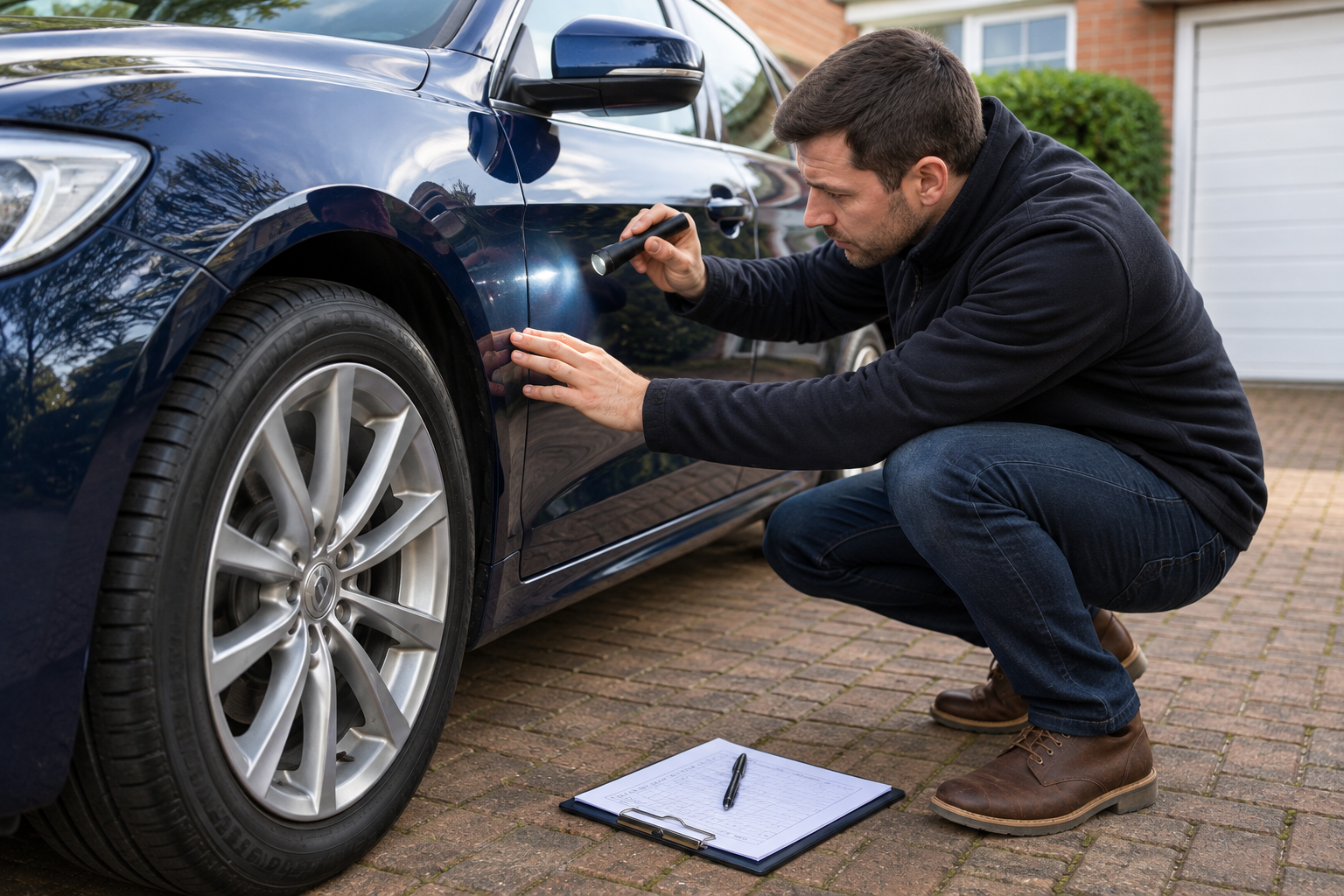
Walk around the vehicle from several angles and compare both sides.
Check:
- Panel gaps for obvious inconsistencies or signs of previous repair
- Paint colour and finish for mismatches or overspray
- Sills, wheel arches and other corrosion-prone areas
- Windscreen and lights for cracks or damage
- Tyres for tread depth, damage and uneven wear
- Wheels for kerbing, cracks or obvious damage
- Number plates for damage and consistency with the V5C registration
Uneven panel gaps can sometimes indicate previous body repair, but they are not proof of accident damage by themselves.
Likewise, uneven tyre wear can have several causes, including wheel alignment, tyre pressures or worn steering or suspension components. Treat it as something to investigate rather than diagnosing the cause from appearance alone.
Interior, Electrics and Controls
Sit in the driver's seat and test the controls you can reasonably operate.
Check:
- Windows and mirrors
- Central locking
- Seats and seat adjustment
- Wipers and washers
- Heater and ventilation controls
- Air conditioning, where fitted
- Exterior and interior lights
- Dashboard warning lights
- Infotainment and other fitted electrical equipment
Look for damp smells, water staining or persistent condensation, as these can indicate a leak or water ingress.
Compare wear on the steering wheel, pedals, seats and gear lever with the mileage and overall age of the vehicle. Heavy wear does not prove that the mileage is wrong, but an obvious inconsistency deserves further investigation.
Dashboard warning lights should illuminate and extinguish as expected for that vehicle. If a warning remains displayed, establish what it means before buying.
Mechanical Checks: Engine, Gearbox and Suspension
Before starting the engine, look around the engine bay for obvious fluid leaks, damaged components or unusually low fluid levels.
If possible, ask to see the vehicle from a cold start. Some starting or running problems are easier to identify before the engine has warmed up.
Check the condition and level of the oil and coolant in accordance with the manufacturer's instructions. Unusual contamination or residue deserves investigation, but appearance alone should not be treated as a definite diagnosis of a particular engine fault.
Listen for unexpected rattles, knocks or rough running.
If you take a test drive, make sure you are legally insured to drive the vehicle first.
During the drive, pay attention to:
- Clutch operation where applicable
- Gear changes
- Acceleration
- Braking
- Steering
- Suspension noise
- Vibration
- Dashboard warning lights
Try to use more than one type of road where it is safe and lawful to do so. Some problems are easier to notice at different speeds or over different road surfaces.
If something feels or sounds wrong, investigate it before committing to the purchase. Depending on the vehicle and the issue, that may mean asking for further evidence or arranging an independent mechanical inspection.
How to Check for Outstanding Finance on a Car
Outstanding finance is particularly important when buying a used vehicle.
With agreements such as hire purchase or conditional sale, the person using the vehicle may not become its legal owner until the agreement has been completed. Selling the vehicle without the finance company's agreement can therefore create an ownership dispute.
A Car Check Scotland Full Check includes an outstanding-finance check against available finance records.
The Basic Check does not include outstanding finance, so choose the Full report when finance information forms part of your buying decision.
You can compare the available report options on the Car Check Scotland vehicle check page.
Watch Out
Do not rely only on a seller saying that a vehicle is "finance clear". Check independently and investigate any finance marker before paying for the vehicle. The legal position is not simply that every innocent buyer automatically loses a vehicle if old finance is later discovered.
Citizens Advice Scotland explains that a private buyer may obtain what is known as good title in certain circumstances involving hire purchase or conditional sale. This can depend on matters including whether the buyer knew about the finance, bought in good faith and was buying privately rather than for resale.
See the current Citizens Advice Scotland guidance on buying a car that is still on hire purchase.
If outstanding finance appears on a vehicle you are considering, resolve it before completing the purchase rather than trying to determine the legal position afterwards.
Paperwork and History: MOT, V5C and Write-Off Categories
Ask to see the V5C registration certificate and compare its vehicle details with the car itself and with DVLA records.
Check:
- Registration number
- Make and model
- VIN or chassis number
- Engine number where shown
- V5C security features
- MOT status and history
- Recorded MOT mileages
- Service and repair records where available
GOV.UK provides a current used vehicle buying checklist, including V5C security and vehicle-identity checks.
The person named on the V5C is the registered keeper. A V5C should not by itself be treated as proof that the named keeper is necessarily the legal owner of the vehicle.
If the person selling the vehicle is not the registered keeper, ask for a clear explanation and satisfy yourself that the seller has the right to sell it.
Check the vehicle's current tax information as part of your research, but remember that vehicle tax does not transfer to the buyer. After buying a vehicle, you must tax it before driving it on the road, or make a SORN where appropriate.
Insurance Write-Off Categories
Recorded insurance write-off information is another important part of the history.
Current UK categories include:
| Category | Meaning | Can the vehicle return to the road? |
|---|---|---|
| A | Vehicle cannot be repaired | No — the entire vehicle must be crushed |
| B | Vehicle cannot be repaired | No — the body shell must be crushed, although some parts may be salvaged |
| S | Repairable structural damage | Yes, if repaired to a roadworthy condition |
| N | Repairable non-structural damage | Yes, if repaired to a roadworthy condition |
A Category S or N marker does not automatically mean a vehicle is unsuitable to buy, but the previous damage, quality of repair, value and current condition should all be considered carefully.
If a write-off marker appears unexpectedly, ask for supporting information and consider an independent inspection.
| Check | What to Look For | Where to Verify |
|---|---|---|
| MOT | Status, history, advisories and mileage pattern | GOV.UK MOT history |
| V5C | Vehicle details, security features and VIN match | Physical document and DVLA information |
| Write-off | Recorded insurance category | Vehicle history check |
| Finance | Outstanding finance record | Full vehicle history check |
| Mileage | Recorded readings and unexplained inconsistencies | MOT history and available supporting records |
How Accurate Is a Vehicle History Report?
A vehicle history report is only as complete as the records available to the data sources behind it.
No report can guarantee that a vehicle is problem-free.
For example, privately repaired damage that was never recorded by an insurer may not appear in insurance-history data. Likewise, records can sometimes be delayed, incomplete or corrected later.
A vehicle history report should therefore be used alongside:
- A physical inspection
- The V5C and vehicle identity
- MOT history
- Service and repair records
- Information supplied by the seller
- An independent mechanical inspection where appropriate
Car Check Scotland offers Basic and Full vehicle history reports.
The Basic Check includes key vehicle information together with MOT and tax information, MOT mileage readings, a police-stolen check and an insurance write-off check.
The Full Check includes everything in Basic and adds the outstanding-finance check, Full mileage verification, valuation, salvage and auction information and further ownership and registration history.
Where account storage is supported, eligible reports purchased while using the account can remain available there for later reference.
Motor traders and other regular users can also view trade checks and report bundles.
When to Seek Professional Assistance
An independent inspection can be particularly useful when:
- The vehicle is expensive
- It is mechanically complex
- It is a performance or specialist model
- Its service or repair history is incomplete
- You have noticed something during your own inspection that you cannot confidently assess
- You cannot inspect the vehicle thoroughly yourself
A mechanic or specialist may be able to inspect areas that are difficult to assess on a driveway, including the underside, suspension and evidence of leaks or previous repair.
For some specialist or performance vehicles, a marque specialist may be more appropriate than a general inspection.
If a seller refuses a reasonable request for an independent inspection, consider that information when deciding whether you are comfortable proceeding.
A mechanical inspection and a vehicle-history report perform different jobs: one assesses the vehicle's current physical condition, while the other checks recorded historical information.
Conclusion
A good used-car buying decision should not depend on one check alone.
Inspect the bodywork, tyres, interior and mechanical condition; compare the VIN and other vehicle details with the V5C; review the MOT and mileage history; and investigate any finance, write-off or stolen-vehicle marker before paying.
Remember that the V5C identifies the registered keeper rather than proving ownership, and that vehicle tax does not transfer automatically when a car is sold.
For recorded history, choose the Car Check Scotland report that matches the information you need. In particular, use a Full Check if you need an outstanding-finance check.
If anything remains unclear after your own checks, obtain further evidence or an independent inspection before committing to the purchase.
Frequently Asked Questions
What are the most common mechanical issues to look for in a used car?
Look for signs that deserve further investigation rather than trying to diagnose a vehicle from one symptom. Examples include fluid leaks, unexpected smoke, unusual noises, rough running, difficult gear changes, steering vibration, abnormal tyre wear or dashboard warning lights. If you are unsure what a symptom means, arrange an independent inspection before buying.
How do I check for outstanding finance on a car?
Ask the seller about any finance, but verify the position independently. A Car Check Scotland Full Check includes an outstanding-finance check against available finance records. The Basic Check does not include outstanding finance. If a finance marker appears, investigate and resolve it before completing the purchase.
What documents should I check when buying a used car?
Ask to see the V5C and compare the vehicle details, VIN and engine number where applicable with the vehicle and DVLA information. Check the MOT history and recorded mileage, and review available service records, invoices and repair documentation. Remember that the V5C identifies the registered keeper and is not proof of legal ownership by itself.
Is a replacement or duplicate V5C automatically suspicious?
No. A replacement V5C can be issued legitimately. Rather than rejecting a vehicle simply because its V5C has been replaced, use the current GOV.UK checks: inspect the document's security features, make sure its details match the vehicle and compare the VIN and other identifying information with DVLA records.
Does vehicle tax transfer to me when I buy a used car?
No. Vehicle tax does not transfer to the new keeper. You must tax the vehicle before driving it on the road after purchase, or make a SORN if the vehicle will be kept off the road and the requirements for SORN are met.
Is it worth getting a professional pre-purchase inspection?
It can be, particularly for an expensive, specialist or mechanically complex vehicle, when the paperwork is incomplete, or when something found during your own inspection needs expert assessment. A physical inspection complements rather than replaces a vehicle-history check because the two examine different types of risk.