Table of Contents
- What Is a Vehicle Finance Marker and Why It Matters
- How to Check for Outstanding Finance on a Car
- What a Vehicle History Check Can Show
- What Happens If You Buy a Car With Outstanding Finance
- How a Finance Record Is Cleared
- Finance Records, Logbook Loans and Common Confusions
- What Sellers and Traders Need to Know
- Conclusion
- Frequently Asked Questions
Last Updated: 20 September 2026
What Is a Vehicle Finance Marker and Why It Matters
A vehicle finance marker is a commonly used description for a record in vehicle-history or finance-industry data indicating that a finance agreement or financial interest is associated with a vehicle.
The exact information shown depends on the data provider and the type of agreement. A marker should therefore be treated as a prompt to investigate the finance position rather than as a complete legal explanation on its own.
For agreements such as hire purchase (HP) and conditional sale, the finance company can retain ownership rights until the agreement is completed. Personal contract purchase (PCP) agreements also normally involve finance-company ownership during the agreement, with the customer having options at the end depending on the contract.
A vehicle history report can help identify recorded outstanding finance before you buy. If finance appears, the important next step is to establish what agreement exists, whether it has been settled and what rights the parties have.
Key Takeaway
A recorded finance marker is an important warning, but the legal position depends on the type of agreement and the circumstances of the sale. Do not assume that a database marker alone answers every ownership question.
How to Check for Outstanding Finance on a Car
A vehicle history check can search recorded finance information associated with a vehicle registration and return any finance entry available to the service.
A sensible process is:
- Check the registration number (VRM) carefully.
- Run a vehicle history check before paying for the vehicle.
- Read the finance section closely.
- If finance is shown, ask the seller for an explanation and appropriate evidence.
- Where possible, obtain written confirmation from the lender that the agreement has been settled or will be settled safely.
- Re-check close to the purchase date if there has been a delay before completion.
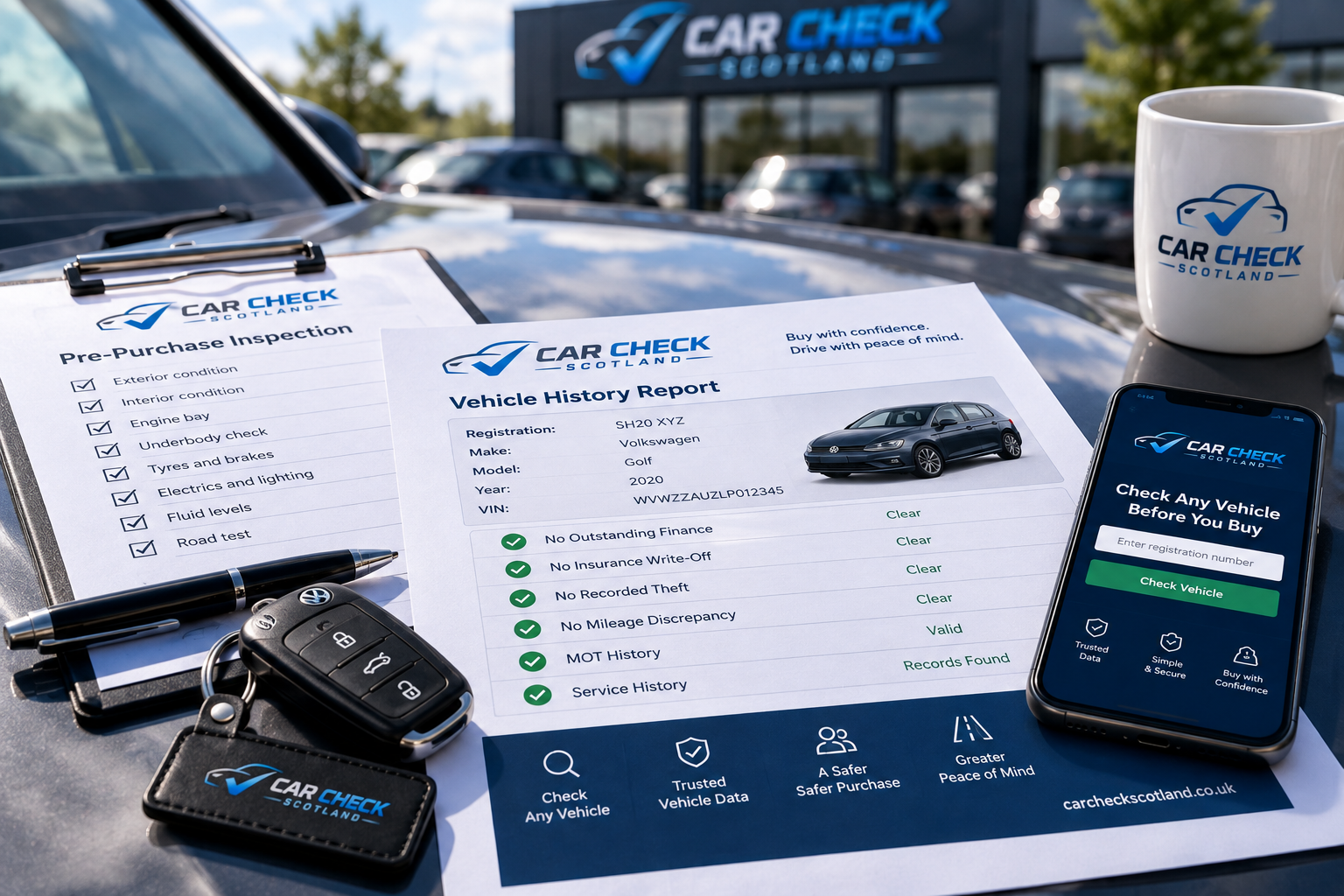
Do not rely solely on a seller saying that finance was “paid off yesterday”. Records can take time to update, and a buyer should establish the position before handing over money.
What a Vehicle History Check Can Show
A Full Vehicle History Check can bring several recorded data points together in one report.
Depending on the data available, Car Check Scotland's Full report can include information such as:
- recorded outstanding finance;
- insurance write-off history;
- stolen-vehicle checks;
- mileage information;
- MOT and tax information;
- registration and specification details; and
- other available vehicle-history data.
A history report is not a guarantee that a vehicle is problem-free. It reports information available from the records and datasets searched at the time of the check. Very recent events, unreported incidents and mechanical faults may not appear.
Guest checkout is available, so an account is not required to buy a report. Customers who choose to create an account can keep eligible purchased reports together for later access.
What Happens If You Buy a Car With Outstanding Finance
Outstanding finance is a serious issue, but the legal position is more nuanced than saying a finance company can always take the vehicle from every later buyer.
Citizens Advice Scotland explains that a private buyer can in some circumstances obtain good title to a vehicle that was still subject to hire purchase or conditional sale.
Its guidance says a private buyer will generally have good title where the relevant conditions are met, including that the buyer:
- did not know the car was subject to HP or conditional sale;
- bought honestly and in good faith;
- was a private buyer rather than someone buying cars to sell or hire out; and
- was the first private buyer to buy from the person subject to the HP or conditional-sale agreement.
Citizens Advice Scotland also explains that, where good title is disputed, it is for the finance company to prove the buyer does not have good title.
That protection does not mean outstanding finance should be ignored. If a finance marker appears before purchase, resolve it before paying wherever possible.
Useful guidance:
If you have already bought a car and a finance company contacts you, get advice before surrendering the vehicle or making further payments to anyone.
How a Finance Record Is Cleared
A recorded finance entry should normally be updated after the underlying finance agreement has been settled and the relevant lender or data source updates its records.
There is no safe universal promise that every finance record will disappear within a fixed number of days. Update times can vary between lenders and databases.
If a seller says the finance has already been settled but the record still appears:
- ask for written settlement confirmation from the lender;
- check that the vehicle and agreement details match;
- allow for a reasonable processing period where appropriate;
- run a fresh vehicle-history check; and
- do not rely solely on a verbal assurance if the record remains unresolved.
Watch Out
Paying the seller does not itself prove that the seller has settled a separate finance agreement. If outstanding finance is recorded, establish how it will be cleared before completing the transaction.
Finance Records, Logbook Loans and Common Confusions
Different finance arrangements can create different ownership and security issues, so it is important not to treat every finance entry as identical.
Hire purchase and conditional sale
Under hire purchase, the customer normally does not own the vehicle until the agreement has been paid in full. Conditional sale is similar, with ownership passing when the conditions of the agreement are satisfied.
Citizens Advice Scotland provides specific guidance on both types of agreement and on the rights of private buyers who unknowingly purchase a vehicle still subject to them.
PCP
Personal contract purchase is a form of vehicle finance where the customer makes payments during the agreement and normally has end-of-term options set out in the contract. The vehicle should not be treated as though the customer automatically owns it outright during the finance term.
Logbook loans in Scotland
Conventional bill-of-sale logbook loans are not available in Scotland.
MoneyHelper explains that logbook loans are available in England, Wales and Northern Ireland, where a bill of sale is used as security. It specifically states that logbook loans are not available in Scotland because a bill of sale is not regarded as legally binding there.
MoneyHelper also notes that someone in Scotland may instead be offered a hire-purchase agreement or conditional sale, which are regulated financial products and carry Consumer Credit Act protections.
Useful source:
So a Scottish article should not describe conventional logbook loans as though they operate here in the same way as they do elsewhere in the UK.
Finance record vs insurance write-off
A finance record and an insurance write-off category are separate issues.
A vehicle can:
- have recorded finance but no write-off history;
- have write-off history but no recorded finance;
- have both; or
- have neither recorded at the time of the check.
Read the sections independently.
What Sellers and Traders Need to Know
A private seller with outstanding finance should deal with it transparently and establish with the lender how the agreement can be settled before or as part of the sale.
For traders, routine vehicle-history checks can help identify recorded finance and other history when acquiring stock or taking part-exchanges.
A practical trade process can include:
- checking the vehicle at intake;
- reviewing any recorded finance;
- obtaining appropriate settlement information where finance exists;
- resolving title and finance questions before resale; and
- keeping records of the checks and settlement evidence.
Car Check Scotland offers trade access and report bundles for eligible motor-trade customers, allowing businesses carrying out regular checks to manage multiple vehicle reports.
Conclusion
A finance marker is useful because it tells you that a recorded finance issue needs investigation, but the marker itself is not the whole legal answer.
Before buying:
- run a current vehicle history check;
- investigate any finance entry;
- ask for written settlement evidence where appropriate;
- do not rely solely on verbal assurances; and
- remember that Scottish good-title rules can affect what happens if a private buyer unknowingly buys a vehicle still subject to HP or conditional sale.
Car Check Scotland provides Full Vehicle History Checks that include recorded outstanding-finance information alongside other available vehicle-history data. Guest checkout is available, while an account is optional for customers who want eligible purchased reports kept together.
Frequently Asked Questions
What does an outstanding finance marker mean on a car?
It means a finance record or financial interest has been reported against the vehicle in the data searched by the history provider. The exact legal effect depends on the type of agreement and the circumstances, so treat the marker as a warning to investigate rather than assuming it answers every ownership question.
Can I buy a car that has a finance marker?
You should not complete the purchase until you understand and resolve the finance position. Ask the seller for settlement evidence and, where appropriate, confirmation from the lender. In Scotland, a private buyer can sometimes acquire good title to a vehicle still subject to HP or conditional sale if the relevant legal conditions are met, but that is not a reason to ignore a finance warning before purchase.
How long does it take for a finance marker to disappear after settlement?
There is no single reliable timescale that applies to every lender and database. Once the agreement is settled, the lender or relevant data source needs to update its records. If the marker remains, obtain settlement confirmation and run a fresh check before relying on the vehicle being clear.
Are logbook loans available in Scotland?
Conventional bill-of-sale logbook loans are not available in Scotland. MoneyHelper explains that a bill of sale is not regarded as legally binding there. Scottish borrowers may instead encounter hire-purchase or conditional-sale arrangements, which operate under a different legal framework.
Can a finance company always repossess a car from an innocent private buyer?
No. Citizens Advice Scotland explains that a private buyer can in some circumstances obtain good title to a car that was still subject to HP or conditional sale, provided the relevant conditions are met. If a finance company disputes ownership after you have bought the vehicle, get advice before giving up the car.
Is a finance marker the same as an insurance write-off?
No. They are separate records. A finance marker relates to a finance agreement or financial interest associated with the vehicle, while a write-off category records an insurer's salvage classification following damage.