Table of Contents
- Why Used Car Buying Carries Risk (and Where It Hides)
- How to Check If a Car Has Outstanding Finance
- Understanding Insurance Write-off Categories Before You Buy
- How to Spot a Clocked Car: Mileage Red Flags
- The Used Car Inspection Checklist for Viewings
- Where a Vehicle History Check Fits Into Used Car Buying
- Negotiating and Walking Away: Turning Checks Into Leverage
- Conclusion: A Calmer Way to Buy Used
- Frequently Asked Questions
Last Updated: 20 September 2026
Why Used Car Buying Carries Risk (and Where It Hides)
Used car buying is a process of gathering evidence before money changes hands, and the risk sits in the gaps between what a seller says and what the records show. This guide from Car Check Scotland walks through the checks that help close those gaps. Outstanding finance, write-off history, clocked mileage and hidden accident damage rarely announce themselves at a viewing. They sit in records, databases and paperwork that a buyer has to actively check.
Problems can surface later, when the buyer tries to sell, insure or part-exchange the car. A vehicle history check is a record-based search of a registration number against sources covering areas such as finance, insurance write-offs, stolen-vehicle records and mileage history. It helps answer questions a test drive cannot.
A practical order is usually best: check the records first, inspect the car second, negotiate third. Doing it in that order can save time, travel and avoidable risk.
How to Check If a Car Has Outstanding Finance
A car with outstanding finance can create serious complications for a buyer, which is why checking before paying a deposit matters. Finance issues are especially important in private sales and trade purchases because the buyer needs to understand whether an agreement is still recorded against the vehicle and whether the seller can pass clear title.
To check whether a car has outstanding finance, run the registration number through a vehicle history check that includes a finance search. The report can show whether a finance agreement is recorded against the vehicle and whether the available record indicates that it has been settled.
Where finance is still active, sensible options include:
- Ask the seller to settle the agreement in full before purchase and provide written confirmation
- Proceed only once the finance position has been clarified properly and appropriate written evidence is available
- Walk away
A verbal assurance that "it's all paid off" is not enough on its own. The recorded finance position and written confirmation matter far more.
Citizens Advice Scotland explains that a private buyer can sometimes obtain good title to a vehicle that was still subject to hire purchase or conditional sale if particular conditions are met. That protection should not simply be assumed, and it does not mean recorded finance can safely be ignored. See Citizens Advice Scotland guidance on a car that is still on hire purchase.
Watch Out
Outstanding finance should always be treated as a serious warning sign. If finance is showing and the position cannot be clearly established, do not rely on a verbal promise that it will be "sorted later". Obtain appropriate written evidence and seek legal or professional advice if ownership or title remains uncertain.
Understanding Insurance Write-off Categories Before You Buy
An insurance write-off category is a classification applied after an insurer writes off a vehicle. That marker can remain part of the vehicle's history and is relevant to value, repairs, insurance and future resale.
The current categories are A, B, S and N. According to GOV.UK guidance on insurance write-offs, Category A vehicles must be crushed completely. Category B vehicles must not return to the road and the body shell must be crushed, although some parts may be salvaged. Category S means the vehicle suffered structural damage. Category N means non-structural damage.
Category S and N vehicles can return to use if repaired to a roadworthy condition, but that does not make them equivalent to a vehicle with no recorded write-off history.
A repaired write-off is not automatically unsuitable, but it is a different proposition from an unrecorded car. Buyers should ask more questions, inspect carefully and take the history into account when considering price and future resale. A history check that includes write-off data helps reveal that record before a buyer commits.
How to Spot a Clocked Car: Mileage Red Flags
A clocked car is one whose odometer has been altered to show lower mileage than the vehicle has actually covered. Mileage manipulation can be difficult to identify from appearance alone, so records are particularly important.
Possible warning signs include:
- MOT records showing a mileage figure lower than an earlier test
- Gaps or unusual changes in mileage across consecutive records
- Heavy wear on the driver's seat, pedal rubbers or controls that appears inconsistent with the claimed mileage
- Service history with missing invoices, stamps or unexplained gaps
Cross-check the odometer against MOT mileage history and the available service records. The GOV.UK MOT history service provides previous test information for vehicles covered by the online service.
A later mileage reading that is lower than an earlier one is a warning sign, but it is not automatically proof of clocking because mileage can occasionally be recorded incorrectly. GOV.UK also provides a process for correcting MOT certificate mistakes.
If the numbers do not line up, ask the seller for an explanation and supporting paperwork. Compare that explanation with the MOT history, service record and any mileage information in the vehicle history report. A discrepancy should be understood before money changes hands. For more detail, see used car mileage checks before buying.
The Used Car Inspection Checklist for Viewings
A used car inspection checklist is a written list of checks carried out in person before purchase, covering paperwork, bodywork, mechanical condition and test-drive behaviour. It turns a viewing from a casual conversation into a more structured assessment.
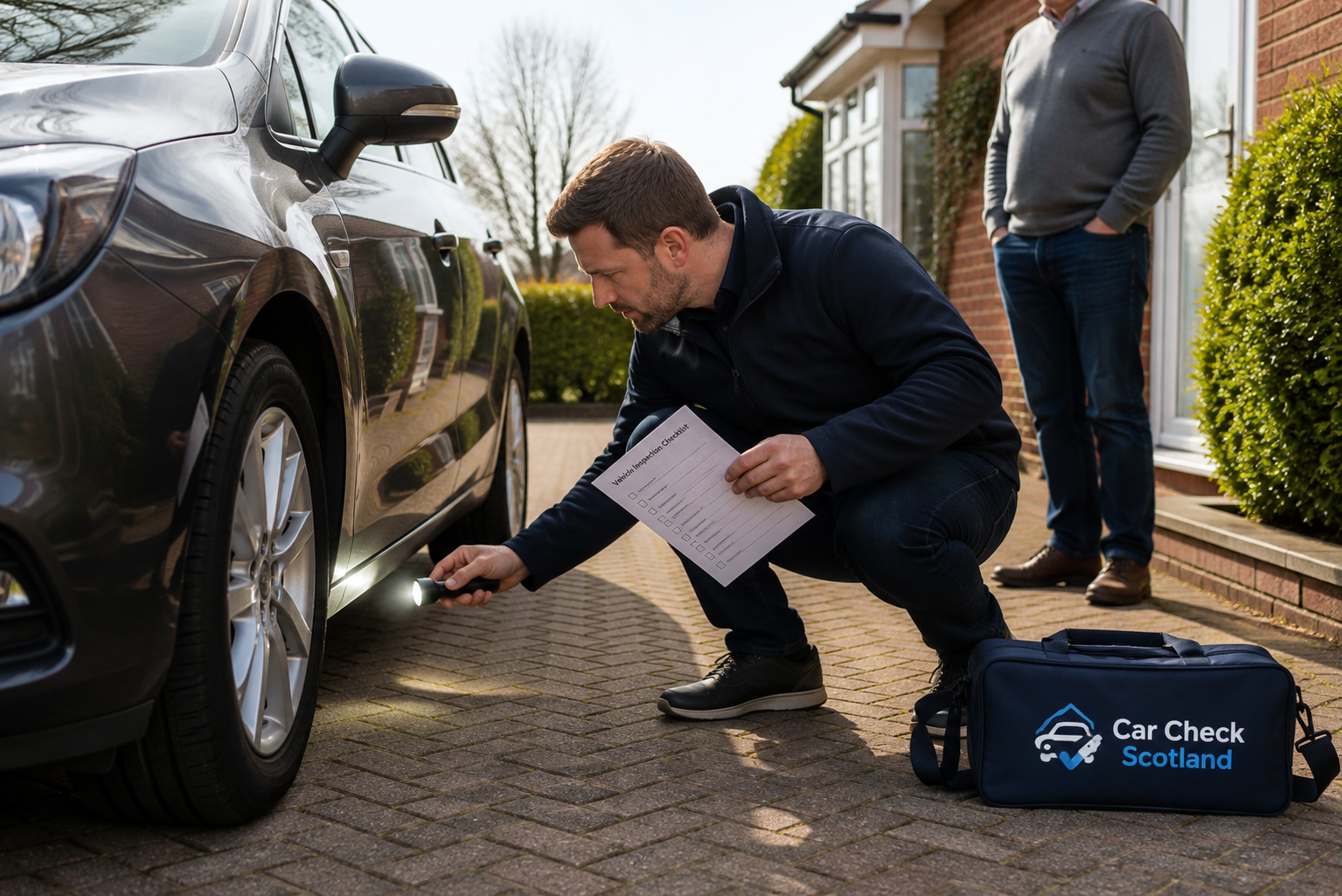
Work through the following at every viewing:
- Registration number (VRM) matches the V5C logbook and the car itself
- VIN on the vehicle matches the V5C
- MOT status and vehicle tax status checked using the relevant government services
- Mileage on the odometer broadly matches recent MOT records and service history
- Bodywork checked in good daylight for mismatched paint, ripples or uneven panel gaps
- Tyres checked for tread depth, condition and uneven wear
- Oil, coolant and brake fluid levels checked where appropriate
- Dashboard warning lights behave as expected during start-up
- Test drive covers a useful range of speeds and manoeuvres where safe and lawful
- Service history, receipts and recent maintenance paperwork reviewed
Pro Tip
Inspect the car in good daylight and, ideally, when the bodywork is clean and dry so paint defects, filler, ripples and panel inconsistencies are easier to spot. Separately, check for signs of water ingress such as damp smells, wet carpets, condensation or water pooling in the boot or footwells.
Where a Vehicle History Check Fits Into Used Car Buying
A vehicle history check is normally most useful before paying a deposit and can often be run before travelling to view the vehicle.
Car Check Scotland provides Basic and Full vehicle history reports covering recorded information such as outstanding finance, insurance write-off history, stolen vehicle status, mileage history, MOT information and vehicle tax information.
Reports purchased while using an account can be kept together for later access where supported by the account. Guest checkout is also available separately, so a guest purchase should not simply be assumed to appear inside an account later.
Eligible motor-trade customers can apply for trade access, and bundle options are available for customers carrying out multiple checks.
For a private buyer, a sensible sequence is to get the registration number from the advert, run the check, review the findings and then decide whether the vehicle is still worth viewing. A recorded issue does not automatically make a car unsuitable, but it may require clarification before proceeding.
For a motor trader taking in stock or a part-exchange, the same process can help identify recorded issues before committing funds.
No history check guarantees that a car is fault-free. It shows what the available records say and should be used alongside inspection, paperwork and appropriate professional advice where needed.
Negotiating and Walking Away: Turning Checks Into Leverage
A history report can be useful during negotiation as well as during initial screening. Findings in the report can help a buyer ask better questions, reassess value and decide whether the car is still worth pursuing.
If the report shows a previous write-off, a mileage discrepancy, MOT concerns or another issue, that does not automatically end the deal. It does, however, change the questions that need to be answered.
The seller may need to explain the record, provide supporting paperwork or reflect relevant history in the asking price. If a significant concern cannot be resolved, walking away remains an option.
Set your own walk-away points before the viewing. Examples might include unresolved finance, a Category A or B marker, identity concerns, or a mileage history that cannot be satisfactorily explained.
Key Takeaway
A stronger buying decision comes from knowing in advance what you need clarified and what you are unwilling to accept. A vehicle history check gives that decision a factual starting point.
Conclusion: A Calmer Way to Buy Used
The risk in used car buying is not that every seller is dishonest. It is that useful information is spread across different records and documents, while a physical viewing can only show part of the picture.
Checking the recorded history before purchase, reviewing the paperwork and inspecting the vehicle can reduce avoidable uncertainty and help a buyer make a more informed decision.
Car Check Scotland provides Basic and Full vehicle history checks, together with bundle options and trade access for eligible motor-trade customers. Guest checkout remains available for customers who do not want to use an account.
If you want purchased reports kept with your account where supported, sign in before completing the purchase.
Frequently Asked Questions
What are the most important checks to perform before buying a used car?
Start by checking the vehicle's identity and paperwork. Match the registration number and VIN to the V5C and the vehicle itself, then review finance, write-off, stolen and mileage records using an appropriate vehicle history check. Check the MOT history, inspect the vehicle carefully and review its service and maintenance records before committing to the purchase.
How can I tell if a used car has outstanding finance?
Outstanding finance cannot usually be identified by looking at the car itself. Use a vehicle history check that searches relevant finance records against the registration number. If finance is recorded, ask for the position to be clarified and obtain appropriate written evidence before proceeding. If ownership or title remains uncertain, seek legal or professional advice.
Why is a vehicle history check useful for used-car buyers?
A vehicle history check brings together recorded information from several areas, such as finance, insurance write-off data, stolen status, mileage records and MOT information. It does not guarantee that a vehicle is fault-free, but it gives the buyer additional evidence to investigate alongside the physical inspection and paperwork.
What does a car's MOT history tell you about its condition?
MOT history shows previous test results, failures and advisories for the items covered by the test. It can help highlight recurring issues and allows you to compare recorded mileage over time. An MOT only reflects the testable items at the time of that test, so it is not a substitute for checking the vehicle's current mechanical and physical condition.
How do I spot a clocked car or mileage discrepancy?
Compare the odometer with mileage recorded in the MOT history, service records and other available history data. A later reading that is lower than an earlier one is a significant warning sign, although recording errors can occur. Investigate any discrepancy and ask for supporting paperwork before deciding whether to proceed.
What are the different insurance write-off categories in the UK?
The current insurance write-off categories are A, B, S and N. Category A vehicles must be crushed completely. Category B vehicles must not return to the road and the body shell must be crushed, although some parts may be salvaged. Category S means structural damage and Category N means non-structural damage. Category S and N vehicles can return to use if repaired to a roadworthy condition, but the recorded write-off remains an important part of the vehicle's history.