Table of Contents
- Why Car Import History Matters Before You Buy
- How to Check If a Car Is an Import
- The DVLA Import Registration Process Explained
- Imported Vehicle Insurance: What to Check
- Red Flags in Imported Car Paperwork and Mileage Records
- How a Vehicle History Check Can Help
- Conclusion
- Frequently Asked Questions
Last Updated: 20 September 2026
Why Car Import History Matters Before You Buy
An imported vehicle can be a perfectly sound purchase, but its history can require more investigation than that of a vehicle originally registered in the UK.
UK records mainly describe the vehicle after it entered the UK registration system. They do not automatically provide a complete account of its earlier life overseas.
That matters because previous damage, mileage records, maintenance or other events may have occurred before the vehicle appeared in UK records.
The aim is therefore to combine several sources of evidence: the vehicle itself, the V5C, available import paperwork, UK registration and MOT records, service documentation and an appropriate vehicle history check.
A UK history check can help identify recorded information available for the vehicle, including an import or export marker where supplied, but it should not be treated as a complete foreign-history database.
How to Check If a Car Is an Import
Do not rely on the age of the number plate or on a registration date alone to decide whether a vehicle was imported.
DVLA can allocate an age-related registration to an imported vehicle where suitable evidence of its age or previous registration is available, so an imported car does not necessarily receive a registration number corresponding to the year it entered the UK.
Start by checking the V5C and comparing its details carefully with the physical vehicle and other available records.
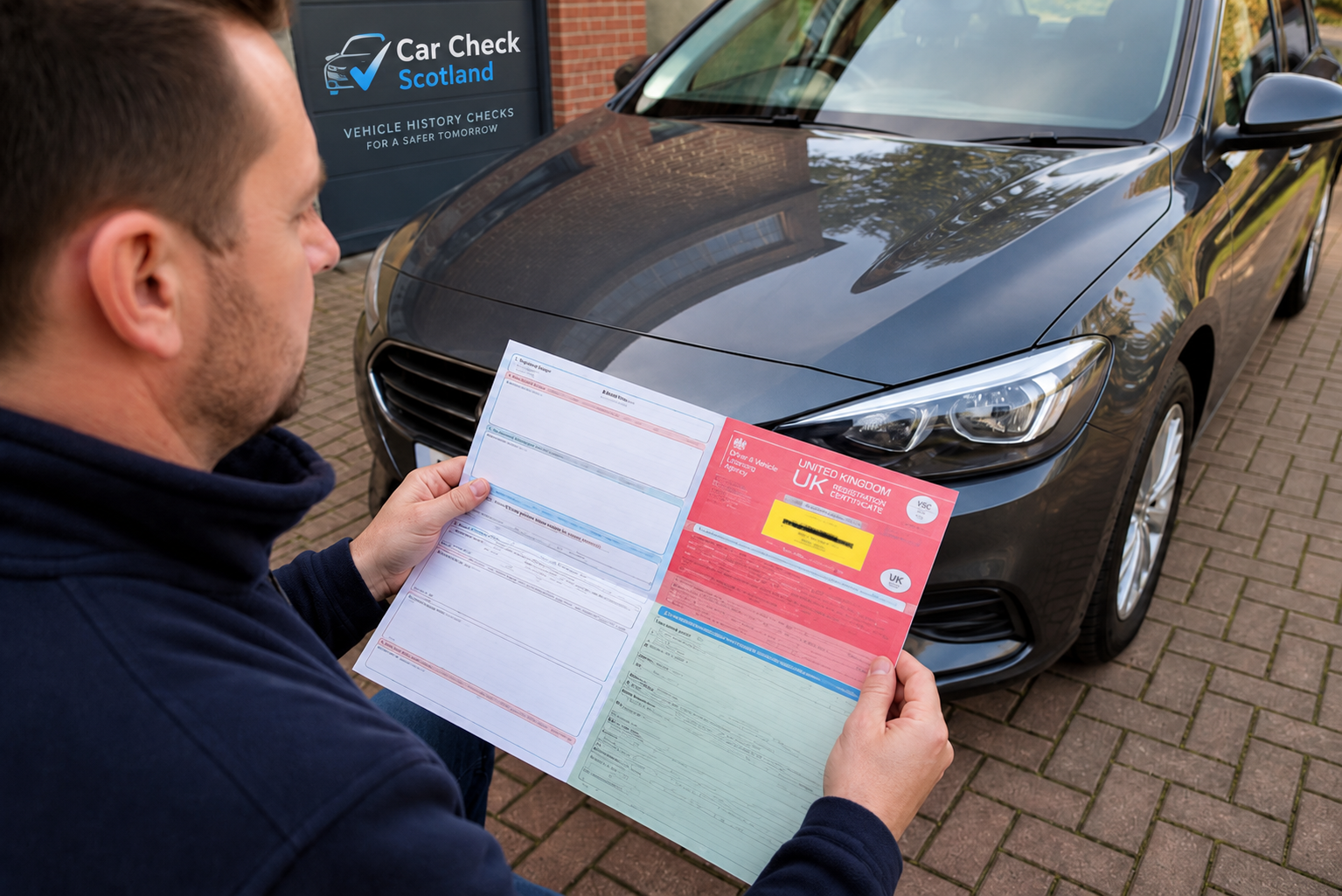
Check the V5C and Vehicle Identity
When viewing the vehicle:
- Ask to see the V5C vehicle registration certificate
- Check that the registration, make, model and other vehicle details are consistent
- Compare the VIN on the vehicle with the VIN recorded on the V5C
- Check the engine number where applicable
- Compare the information with DVLA records
- Ask the seller what documentation exists from the vehicle's import and pre-UK history
The V5C is important evidence about the vehicle's UK registration record, but it is not proof that the vehicle has never been damaged, written off or altered.
A registration number that appears newer or older than expected should prompt further checking, not an automatic conclusion about the vehicle's history.
The DVLA Import Registration Process Explained
A vehicle being brought permanently into the UK must normally go through the appropriate HMRC and DVLA processes before it can be registered for normal UK road use.
The exact requirements depend on matters such as where the vehicle came from, whether it is new or used, whether tax or duty is due and whether vehicle approval is required.
For a permanent import into Great Britain, the normal process can involve:
- Completing any import declaration that is required
- Telling HM Revenue & Customs about the vehicle
- Paying any VAT or customs duty that is due
- Obtaining any required vehicle approval or evidence of exemption
- Applying to DVLA for registration and vehicle tax
- Insuring the vehicle before using it on public roads
Always use the current GOV.UK vehicle import guidance because the rules differ according to the vehicle and circumstances.
HMRC, NOVA and First UK Registration
For most permanent vehicle imports, HMRC must be notified before DVLA can complete the registration.
GOV.UK says HMRC should normally be told within 14 days of a vehicle being brought permanently into the UK. How this is done depends on whether the vehicle is entering Great Britain or Northern Ireland and on the importer's circumstances.
For relevant vehicles, the Notification of Vehicle Arrivals process — usually called NOVA — is used to notify HMRC.
See the current HMRC guidance on notifying a vehicle arrival.
After the relevant HMRC requirements are complete, the vehicle can proceed through the applicable DVLA registration process.
DVLA currently uses:
- V55/4 for new vehicles, including new imported vehicles
- V55/5 for used vehicles, including used imported vehicles
Supporting evidence depends on the vehicle and circumstances. It can include identity documents, foreign registration documentation and evidence of vehicle approval, together with other information requested by DVLA.
See GOV.UK guidance on registering an imported vehicle.
Watch Out
When buying a used vehicle, check that the V5C exists and that its vehicle identity details match the car. Do not assume that registration paperwork by itself proves the vehicle's complete previous history.
Imported Vehicle Insurance: What to Check
Insurance terms for imported vehicles vary between insurers and between vehicles.
An insurer may need to know that the vehicle is imported, whether it differs from the equivalent UK specification and whether it has been modified.
Before buying an imported vehicle:
- Tell the proposed insurer that the vehicle is an import
- Give accurate details about its specification
- Disclose relevant modifications
- Ask whether the insurer needs any additional documentation
- Obtain a quotation before committing to the purchase
Do not assume that every imported vehicle is automatically more expensive to insure or that every insurer will treat it in the same way.
The important point is to give the insurer accurate information and confirm the cover and terms for the particular vehicle.
Red Flags in Imported Car Paperwork and Mileage Records
Imported vehicles can legitimately have shorter UK record histories because part of their life took place abroad.
For example, UK MOT records beginning only after the vehicle entered the UK are not automatically suspicious.
Instead, look for inconsistencies that cannot readily be explained.
Things worth investigating include:
- V5C details that do not match the physical vehicle
- VIN inconsistencies
- Conflicting dates across documents
- Unexplained mileage reductions
- Mileage units switching between kilometres and miles without a clear explanation
- Missing paperwork where the seller claims specific import or ownership history
- A seller who cannot give a reasonable explanation of when or how the vehicle entered the UK
A mileage discrepancy is a reason to investigate further, not proof that a vehicle has been clocked.
Imported vehicles may have records in kilometres, miles or a mixture of both. Convert units where necessary and compare the figures with service records, invoices and other available evidence before reaching a conclusion.
Pro Tip
A seller may not possess the original foreign registration certificate because original documents can be submitted as part of the DVLA registration process and may not be returned. Ask instead for any copies, scans, import invoices, foreign service records or other provenance documents that remain available.
How a Vehicle History Check Can Help
A UK vehicle history check can bring together useful recorded information about a vehicle after it has entered the UK data system.
Car Check Scotland provides Basic and Full vehicle history reports.
The Basic Check includes key vehicle information together with MOT and tax information, MOT mileage readings, a police-stolen check and an insurance write-off check.
The Full Check includes everything in Basic and adds the outstanding-finance check, Full mileage verification, valuation, salvage and auction information and further ownership and registration history.
Recorded import or export status may also be available where it is supplied for the vehicle.
However, a UK report should not be presented as a complete record of everything that happened to an imported car overseas.
A field describing a vehicle's country of origin can refer to manufacturing or model information. It should not automatically be interpreted as the country in which that particular used vehicle was previously registered.
For that reason, overseas registration, servicing, accident or ownership history may require separate supporting evidence from the seller or relevant foreign sources.
You can compare the report options on the Car Check Scotland vehicle check page, or see trade checks and report bundles for businesses checking vehicles regularly.
Where account storage is supported, eligible reports purchased while using the account can remain available for later reference.
A history report cannot guarantee that a car is problem-free and does not replace a physical inspection.
Conclusion
An imported vehicle should not automatically be treated as a bad purchase, but buyers should recognise that its UK record may cover only part of its life.
Check the V5C and VIN carefully, understand the vehicle's UK registration history, examine the available import and service paperwork, investigate mileage discrepancies and obtain an insurance quotation before buying.
A Car Check Scotland report can add useful UK-recorded information, including relevant risk markers and recorded import or export status where available.
The strongest buying decision comes from combining the recorded history with the paperwork and a proper physical inspection rather than relying on any single source.
Frequently Asked Questions
How can I check if a car has been imported into the UK?
Start with the V5C, the vehicle identity details and the available UK history. Compare the VIN on the vehicle with the V5C and DVLA information, ask the seller for any surviving import paperwork and check whether the vehicle history data contains a recorded import marker. Do not rely only on the apparent age of the registration number.
Does Car Check Scotland show whether a vehicle is imported?
Recorded vehicle data can include an imported or exported marker where that information is supplied for the vehicle. Availability depends on the records returned for that registration, so the report should be considered alongside the V5C and other supporting evidence.
Does the country of origin tell me where an imported car was previously registered?
Not necessarily. A country-of-origin field can describe the vehicle's manufacturing or model origin. It should not be treated as proof that the individual vehicle was previously registered in that country.
What form is used to register an imported vehicle with DVLA?
DVLA currently uses V55/4 for new vehicles, including new imports, and V55/5 for used vehicles, including used imports. The supporting documents and any approval requirements depend on the vehicle and circumstances, so check the current GOV.UK guidance before applying.
Should an imported car have UK MOT records from before it entered the UK?
No. A vehicle that was not yet registered or used in the UK would not be expected to have an ordinary UK MOT history covering its earlier overseas life. What matters is whether the records that do exist are consistent and whether any discrepancies can be explained.
Are imported vehicles harder to insure?
Not necessarily. Insurance availability, premiums and terms depend on the insurer and the individual vehicle. Tell the insurer that the vehicle is imported, give accurate specification and modification details and obtain a quotation before buying.